“Welcome One Another”
Notes
Transcript
It has been five months since the Lord called my family to join yours. We’ve learned that much about Midland in that time. We’ve learned you wait a beat when the light turns green, that folks hold strong opinions about the best Mexican food, and that maroon vs. purple is a running debate in this town.
But it was that very first weekend at the end of June that stands out to me. My family had come to town on the heels of a mission trip and on a Saturday evening, we met many of y’all for the first time. Y’all remember it, I bet. There was a wonderful spread of sweet and savory goodies in the fellowship hall. Everyone was very patient as they waited in line to visit with my wife and me. And at the end of that gathering was an incredibly holy moment: members of the search committee, sensing our exhaustion, came by our side…encouraged us, laughed with us, and gave my family a basket. It wasn’t the things in that basket that made it memorable, although we wear the Fannin shirts often and have had to use the allergy medicine that was included. It was the welcome. We were about to move our lives five hours from everything we knew, but what that welcome told us was that we weren’t visitors. We were home. That moment is why Romans 15 lands so personally for me today.
That’s the power of welcome. A sincere welcome can do what sermons and programs sometimes can’t—it opens the heart. And it opens the heart because it reflects the heart of Christ.
But if we’re honest, real welcome isn’t always easy. Because behind our smiles, most of us carry stories that make it hard to let people close. Maybe someone once betrayed your trust. Maybe a church you loved hurt you deeply. Maybe you’ve watched friendships drift apart over politics, preferences, or personalities. And so you start to protect yourself—smiling on Sunday, but never letting anyone get too close.
Some of us have even learned to spiritualize it: “I’m fine just worshiping Jesus on my own.” But isolation isn’t holiness; it’s self-protection dressed up as wisdom. And the problem is, when everyone keeps their distance, no one heals. Scripture won’t shame you for being cautious, but it does call you into a family.
That’s not new. The believers Paul wrote to in Rome knew the same tension. They were a divided church—Jewish believers who had centuries of law and tradition and they were sitting next to Gentile believers who’d never followed those customs. Different backgrounds, different expectations, same Savior. But the cracks were showing. They were worshiping in the same building but not with the same heart.
And right into that mixture, Paul writes we read to start from Romans 15.
Paul knew something we often forget—that unity doesn’t happen automatically. It has to be cultivated. And it starts with a posture of welcome.
Here’s the tension for us, church family: we love Jesus, we love each other, but we sometimes live like acquaintances instead of a family. We know how to shake hands, but not always how to open hearts. We’re polite, but not always present. And with wounds still healing here, presence is part of how God mends us.
So the question this morning is simple, but it cuts deep:
What kind of welcome are we offering—in our homes, in our seats, in our hearts?
Because the gospel doesn’t just call us to gather; it calls us to embrace. Jesus didn’t wave from a distance—he came near. And if we’re going to look like him, our church must become the kind of place where no one stays a stranger for long. The welcome we’ve received becomes the welcome we extend.
Paul begins this section of Romans with a prayer, not a command. He writes, Romans 15:5
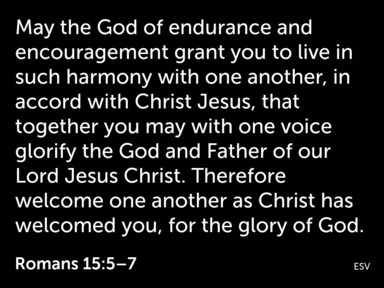
May the God of endurance and encouragement grant you to live in such harmony with one another, in accord with Christ Jesus,
Welcome One Another Because It Reflects the Heart of God
Welcome One Another Because It Reflects the Heart of God
That’s important. Before Paul ever tells believers what to do, he reminds them who God is. Because true welcome doesn’t start with personality—it starts with theology. It starts by remembering that God himself is welcoming by nature. He is, as Paul says here, the “God of endurance and encouragement.”
Let’s think about those two words for a moment.
Endurance means God doesn’t give up on his people. He keeps pursuing, keeps inviting, keeps restoring. If you’re saved today, it’s because God refused to walk away when you wandered. He didn’t say, “I’ve had enough.” He waited. He endured.
Encouragement means he lifts us up when we’re weak. He meets us in our failure and speaks life into us. He reminds us of who we are when we forget. And he does it supremely in Christ—who comes near, bears our sin, and brings us in.
Church family, that’s what welcome looks like in motion. It’s endurance and encouragement with skin on it. It’s saying to a brother or sister, “You don’t have to perform to belong. You don’t have to earn your seat at the table. You’re loved because Christ loves you.” 1 John 4:19 “We love because he first loved us.”
Now, think about how different that is from how most of the world works. Out in Midland, we size people up by what they bring to the table—what they drive, what they do, who they know. But God’s welcome isn’t transactional; it’s transformational. He doesn’t invite us in because of what we offer.
And if that’s the kind of God we serve…then that’s the kind of people we’re called to be.
When Paul prays that believers would “live in harmony with one another,” he’s not talking about fake peace—the kind where everyone smiles but nobody’s honest. He’s talking about a supernatural unity that only the Spirit can produce. A harmony that can only happen when we’re all tuned to the same note—Jesus Christ.
It’s like the songs we sang together today. Did you notice they all started with an instrument leading off? It’s so everyone else can be tuned in to that first note, so that noise becomes music.
That’s what happens when the church takes its cue from the heart of God.
When we welcome like Jesus welcomes—patiently, faithfully, joyfully—the noise of self-interest turns into the music of grace.
And here’s the beauty of it: the longer you walk with Christ, the more you start to resemble his rhythm. The more you’ve been welcomed by Jesus, the more you want others to experience that same grace.
So before we talk about how to welcome one another, we start here—with the One who never stopped welcoming us.
Because every open heart and every open door in the church is a reflection of Jesus’. His cross is the doorway; His resurrection is the invitation to come in.
Paul continues his prayer:
May the God of endurance and encouragement grant you to live in such harmony with one another, in accord with Christ Jesus, that together you may with one voice glorify the God and Father of our Lord Jesus Christ.
Welcome One Another Because It Leads to Gospel Harmony
Welcome One Another Because It Leads to Gospel Harmony
Do you hear the shift? God’s welcome doesn’t stop with individuals—it creates a community. Paul’s vision for the church isn’t a room full of isolated believers singing their own tune; it’s a choir, different voices blending into one beautiful sound.
But that harmony doesn’t come naturally. It takes the work of God’s Spirit and the humility of God’s people.
Now, harmony doesn’t mean sameness. You can’t have harmony if everyone sings the same note. Harmony happens when different notes are tuned to the same key. That’s why Paul says, “in accord with Christ Jesus.” He’s the tuning fork for the church. The only way we sing in sync is if we’re listening to him.
Here’s where this gets real for us. Churches fall out of tune not because of different opinions but because we stop listening to the same voice. When our preferences get louder than our praise, dissonance follows.
You’ve probably seen that happen. Maybe you’ve even felt it—how small things become big things when our eyes drift off Jesus. Somebody doesn’t get asked to serve on a committee. Someone else feels forgotten or misunderstood. Before long, what was once unity feels like tension.
And sometimes, it’s something as simple—and as heartfelt—as how we experience worship together.
Some of us love when the music is loud—not to drown anyone out, but because it helps us sing without fear. There’s something freeing about lifting your voice when you can’t quite hear yourself. You feel that passion, that energy, that “Let’s all sing loud for Jesus!” spirit.
Others, though, prefer it a little quieter—not because they don’t want to sing, but because they do. They want to hear the people of God singing beside them. For them, it’s that sense of togetherness, of faith echoing faith across the room, that captures the beauty of worship.
Now if we’re not careful, we can start talking past one another. But here’s the truth: both groups are trying to do the same thing—worship Jesus. One values the boldness of joyful noise; the other values the beauty of corporate harmony. Both are biblical. Psalm 100 says, “Make a joyful noise to the Lord,” and Ephesians 5 says, “Sing to one another with psalms and hymns and spiritual songs.”
See what’s happening? We’re not disagreeing about why we worship—we just experience how that worship moves our hearts differently.
But the gospel calls us higher. Worship was never meant to be a competition of preferences; it’s a collaboration of praise.
When Paul prays that we would glorify God “with one voice,” he’s not saying we all have to sound the same—he’s saying our hearts have to be tuned to the same note: Jesus.
So the question isn’t, “Is it too loud or too soft?” The question is, “Are we listening to one another as we worship the same Savior?” Love will sometimes choose to turn it up; love will sometimes choose to turn it down—so that together we can turn our hearts to Jesus.
Because the miracle of the church isn’t that everyone agrees on the mix levels—it’s that people with different ears, voices, and experiences lift up one name together: Jesus Christ.
That’s harmony. That’s what the world can’t explain but desperately needs to see.
And when that kind of unity fills a room—when a church family sings and serves and lives “in accord with Christ Jesus”—the world doesn’t hear competing opinions; it hears one clear song: “To God be the glory.”
That’s why Paul says, “that together you may with one voice glorify the God and Father of our Lord Jesus Christ.” Because when the people of God choose harmony over hostility, Jesus becomes audible again in Midland.
Paul closes this section with one of the simplest yet most powerful commands in the New Testament:
Therefore welcome one another as Christ has welcomed you, for the glory of God.
Welcome One Another Because Christ Has Welcomed You
Welcome One Another Because Christ Has Welcomed You
Everything he’s been building toward lands right here. Why do we bear with each other’s weaknesses? Why do we choose harmony over hostility? Why do we keep loving people who are sometimes hard to love?
Because that’s exactly what Jesus did for us.
Think about how radical this is. Jesus didn’t welcome us because we were easy to love. He didn’t wait for us to get our act together, clean ourselves up, or prove we were worthy of belonging. He welcomed us while we were still sinners (Romans 5:8). He bore our rejection so we could know his reception.
That’s what makes the gospel so astonishing. Jesus opened his arms to people like us—broken, stubborn, inconsistent people—and said, “You have a place here. You belong to Me.”
And Paul says, now go and do the same.
That’s the heart of Christian community. We don’t welcome others because they fit our preferences. We welcome them because Christ welcomed us when we didn’t fit at all.
Now, in the early church, this was a big deal. The Roman believers were divided—Jew and Gentile, old traditions and new freedoms, long-time members and recent converts. Each group thought the other should adapt to their way of doing things. Paul steps in and says, “Stop drawing lines Jesus already erased.” For us, that means we don’t redraw the old lines of hurt; we redraw the circle of welcome around the cross.
And if you think about it, the same temptation still lives in churches today. We might not divide over circumcision or food laws—but we can divide over methods, generations, backgrounds, or even what people wear to church.
But the gospel cuts through all of that. Christ didn’t welcome us because we looked alike, voted alike, or worshiped alike. He welcomed us because his blood made us family.
And when we start to live that way—when the people of God open their hearts and homes and chairs and schedules to one another—the watching world gets a glimpse of heaven.
I remember when we moved in to our home here in Midland. We’d been here a few weeks. Boxes were everywhere, and the house was chaos. But then, one after another, people from this church started showing up. Someone brought dinner. Our beds are getting assembled. In 24 hours we’ve got pictures on the wall and a single box to deal with.
Those small acts of hospitality spoke volumes. We didn’t just feel welcomed into a church building; we felt welcomed into a family.
That’s what Paul’s talking about here. Welcome one another as Christ has welcomed you. He’s not talking about polite smiles or quick handshakes—he’s talking about gospel-shaped hospitality.
Hospitality that says, “You don’t have to earn your place here.” “You don’t have to pretend here.” “You don’t have to hide here.” And this welcome isn’t just inward; it’s outward—extended to neighbors and nations.
And church family, that kind of welcome has power. Because when someone walks through those doors—hurting, doubting, exhausted by life—and they find not just a service but a Savior’s love reflected in Jesus’s people…let me tell you, that preaches. It preaches louder than any sermon.
Maybe that’s why Paul ends this verse with the phrase “for the glory of God.” When we welcome one another like Jesus welcomed us, God gets the glory because the world sees what his grace can do.
That’s what Midland needs to see—not just a friendly church, but a gospel-welcoming church. A place where the lonely are known, the sinner finds grace, and every person—whether they grew up in church or just wandered in—hears, “You belong here because Christ has made a place for you.”
And maybe for some of you this morning, that’s exactly what you need to hear. You’ve been standing on the edges—looking in, wondering if God could really welcome you.
The answer of the cross is yes. Turn from sin and trust the crucified and risen Christ; he will not cast you out (John 6:37).
The arms of Jesus are still open. The same Savior who carried your sin to the cross now offers you rest, forgiveness, and belonging in him.
So, church family, as we come to the end of this series, let’s make sure our welcome reflects his. Because the most Christlike thing a church can do is this:
Welcome one another, as Christ has welcomed you—so that all of Midland might see God’s glory.
Church family, here’s where it all comes together. We’ve seen that God welcomes us in Christ, that he calls us to live in harmony with one another, and that our welcome is meant to show the world what Christ’s love looks like.
So how do we take that from the page to the people sitting beside us, or to the neighbors living next door?
Let’s start here: Welcome is not a ministry department; it’s a ministry mindset.
Hospitality isn’t just for greeters or committees—it’s for followers of Jesus Christ. Paul doesn’t say, “Those with extroverted personalities, welcome one another.” He says, “All of you, welcome one another as Christ has welcomed you.”
And that means this—every time you walk into this church, every time you talk to someone in the hallway, every time you see a new face, you have an opportunity to represent Jesus himself.
Let me make it practical. When someone new walks through those doors, and you go out of your way to introduce yourself—to remember their name, to invite them to lunch, to make them feel seen—you’re not just being friendly. You’re being faithful. Romans 15:7 “as Christ has welcomed you”
When you choose to forgive another Christ follower who hurt you, or sit next to someone you’ve quietly avoided, you’re not just being polite—you’re being Christlike.
When you open your home for a meal, or your group for a visitor, or your life for someone who’s lonely—you’re showing them what grace looks like in the flesh.
Because here’s the bottom line:
Welcomed people welcome people.
Welcomed people welcome people.
That’s the message of this passage. That’s the thread running through this entire series. Every “one another” command we’ve studied—love, encourage, forgive, bear, and now welcome—flows from the same source: Jesus.
You can’t love like that unless you’ve been loved like that. You can’t welcome like that unless you’ve been welcomed like that.
And maybe that’s exactly what God is whispering to some of you this morning—“You don’t have to stand on the edges anymore.” You don’t have to wonder if you belong. You don’t have to earn your way in. Christ has already opened the door.
That’s the gospel. The Son of God stepped into our world, took our sin, bore our shame, and then rose again so that sinners could be welcomed home to God.
You don’t need a ticket, a title, or a résumé—you just need to trust him and then follow him. And if you’ve never done that, today can be the day you walk through that open door.
In just a few moments, when we pray, you can say to him right where you are, “Lord Jesus, I need Your forgiveness. I believe You died for me and rose again. Forgive my sin. Welcome me into Your family. I give my life to follow You as Lord.”
That’s not religion—that’s relationship. That’s grace. And if you’ll take that step, Christ will meet you right where you are, arms wide open.
Now, church family, imagine what could happen in Midland if we lived this out.
What if people started saying, “I don’t know what’s going on over there at Fannin Terrace, but those people really love each other”? What if someone who’s been burned by church walked through our doors and found healing instead of judgment? What if the lonely, the skeptical, and the broken all found a place to belong because they felt seen, known, and welcomed by us?
That’s not just wishful thinking—that’s revival. Because true revival isn’t just about noise in the sanctuary; it’s about warmth in the welcome.
Jesus said in John 13:35, “By this all people will know that you are my disciples, if you love one another.” That’s how the gospel becomes visible in a watching city—when the church stops guarding its comfort and starts sharing its compassion.
And let’s be honest—Midland needs that. We’re surrounded by people chasing success, chasing belonging, chasing peace. But none of those things last without Christ.
The welcome we extend might be the doorway God uses to bring someone home.
So how do we live this out starting today? Let me give you three simple steps:
Look around.
Look around.
Before you leave this building, notice someone you don’t know. Walk across the aisle, across the parking lot if you have to—and introduce yourself. A conversation can be the first bridge to Christ’s welcome.
Lean in.
Lean in.
Stop seeing differences as distractions and start seeing them as design. Different generations, personalities, backgrounds—those aren’t obstacles to unity; they’re opportunities for the gospel to shine. Don’t pull away when it’s uncomfortable—lean closer.
Live it out.
Live it out.
Take the spirit of welcome beyond Sunday. Invite a neighbor to your table. Share your story at work. Be the kind of person who makes others curious about Jesus because they’ve experienced his warmth through you.
And here’s the promise: when the church welcomes like that, God gets the glory, Christ gets the spotlight, and the world gets a glimpse of heaven.
Because the church that welcomes one another becomes a living signpost that says, “There’s room for you at the cross.”
So this week, as you go about your routines—office meetings, grocery runs, backyard conversations—remember this:
Welcomed people welcome people.
Welcomed people welcome people.
And when we live that truth together, Midland won’t just hear about the love of Jesus—they’ll see it, feel it, and be drawn to it.
That’s what it means to “welcome one another as Christ has welcomed you—for the glory of God.”
